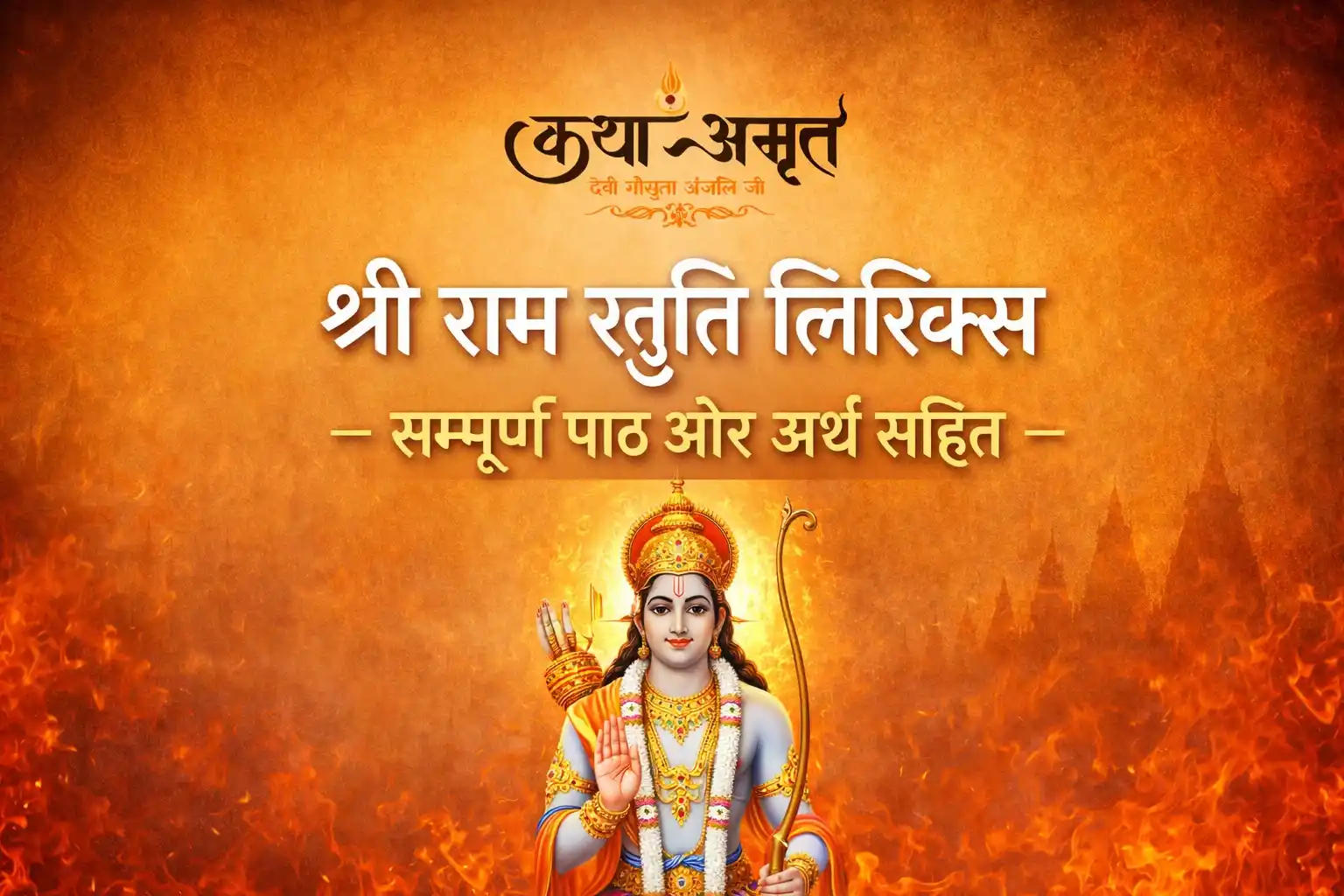
Shri Ram Stuti Lyrics — Complete Guide with Meaning, Importance and Chanting Benefits
Table of Contents
- Introduction — Why Ram Stuti Matters in Ram Katha
- What is Shri Ram Stuti? Definition and Origin
- Complete Shri Ram Stuti Lyrics (Hindi + Transliteration)
- Mangalacharan (Opening Prayer)
- Main Stuti — All Stanzas
- Closing Shloka and Phalshruti
- Word-by-Word Meaning and Significance
- Spiritual Benefits of Chanting Shri Ram Stuti
- How to Chant Ram Stuti — Step-by-Step Guide
- Shri Ram Stuti in the Context of Ram Katha
- Other Popular Ram Stutis You Should Know
- Frequently Asked Questions (FAQs)
- Conclusion and Call to Action
1. Introduction — Why Ram Stuti Matters in Ram Katha
Have you ever sat through a Ram Katha and heard the priest or narrator burst into a melodious Stuti — that divine hymn that instantly hushes the crowd and sends a wave of goosebumps through the entire gathering? That profound moment is the power of Shri Ram Stuti. Whether you are a dedicated devotee seeking the exact Shri Ram Stuti lyrics for your daily puja, a Ram Katha narrator looking for an authentic recitation guide, or a curious soul trying to understand the meaning behind every word — you have come to the right place. In this comprehensive guide, we break down the complete Shri Ram Stuti lyrics in Hindi, their transliteration, word-by-word meaning, spiritual significance, and a step-by-step chanting guide. By the end, you will not just know the lyrics — you will understand the soul behind them.
जय श्री राम 🙏
2. What Is Shri Ram Stuti? Definition and Origin
Featured Snippet Answer: Shri Ram Stuti is a sacred devotional hymn (stuti = praise poem) composed in honor of Lord Ram, the seventh avatar of Vishnu and the hero of the Ramayana. These stutis are recited during Ram Katha, Ram Navami, and daily worship to invoke Lord Ram blessings of righteousness (dharma), protection, and moksha. The word Stuti (स्तुति) in Sanskrit literally means "praise," "eulogy," or "an act of glorification." In the devotional tradition of Hinduism, a Stuti is not merely a poem — it is a spiritual tool that creates a resonance between the consciousness of the devotee and the divine energy of the deity being praised. Shri Ram Stutis have roots in multiple ancient scriptures, including the Valmiki Ramayana, Ramcharitmanas by Goswami Tulsidas, the Adhyatma Ramayana, and the Agastya Samhita. Different traditions recite slightly different versions, but the core essence remains the same — the glorification of Maryada Purushottam Ram.
Key Attributes Praised in Ram Stutis
- Shripati (consort of Sita) — Ram as the embodiment of divine prosperity
- Maryada Purushottam — Ram as the ideal man, the best among mortals
- Raghuvanshi — Ram as the crown jewel of the Raghu dynasty
- Dinavatsala — Ram as the protector of the meek and suffering
- Karunasindhu — Ram as the ocean of compassion
- Dasharathi — Ram as the beloved son of King Dasharatha
- Janaki Vallabh — Ram as the beloved lord of Sita
3. Complete Shri Ram Stuti Lyrics
Below you will find the complete Shri Ram Stuti lyrics most commonly recited during Ram Katha events across India, accompanied by Roman transliteration and meaning. This version is rooted in the Ramcharitmanas tradition and is widely recognized.
Mangalacharan (Opening Invocation)
Verse 1
श्री रामचन्द्र कृपालु भज मन हरण भव भय दारुणम्। नव कञ्ज लोचन, कञ्ज मुख, कर कञ्ज, पद कञ्जारुणम्॥
Shri Ramachandra Kripalu Bhaja Mana Harana Bhava Bhaya Darunam। Nav Kanj Lochan, Kanj Mukh, Kar Kanj, Pad Kanjarunam॥
Meaning: O mind! Worship the merciful Shri Ramachandra who destroys the terrible fear of the cycle of birth and death. His eyes are like freshly bloomed lotuses, his face is like a lotus, his hands are like lotuses, and his feet are of a reddish lotus hue.
Verse 2
कन्दर्प अगणित अमित छवि, नव नील नीरज सुन्दरम्। पटपीत मानहु तड़ित रुचि-शुचि नौमि जनक सुतावरम्॥
Kandarp Aganit Amit Chavi, Nav Neel Niraj Sundaram। Patpeet Manahu Tadit Ruchi-Shuchi Naumi Janak Sutaavaram॥
Meaning: He whose beauty is equivalent to innumerable Kamadevs (Cupids), who resembles a fresh blue lotus in radiance, whose yellow garment shines like lightning — I bow to such Shri Ram, the beloved of Janaki (Sita).
Main Stuti — Core Verses
Verse 3 — The Shelter of the Fallen
भजु दीन बन्धु दिनेश दानव दैत्य वंश निकन्दनम्। रघुनन्द आनन्द कन्द कोशल चन्द दशरथ नन्दनम्॥
Bhaju Deen Bandhu Dinesh Danav Daitya Vansh Nikandanam। Raghunannd Aanand Kand Koshal Chand Dashrath Nandanam॥
Meaning: Worship the friend of the meek, the sun among men, the destroyer of the demon lineage. He is the joy of the Raghu clan, the source of bliss, the moon of Koshal, and the beloved son of Dasharatha.
Verse 4 — Ram Divine Form
सिर मुकुट कुण्डल तिलक चारु उदार अंग विभूषणम्। आजानु भुज शर चाप धर, संग्राम जित खर दूषणम्॥
Sir Mukut Kundal Tilak Charu Udar Ang Vibhushnam। Aajanu Bhuj Shar Chaap Dhar, Sangraam Jit Khar Dushanam॥
Meaning: He wears a crown on his head, beautiful earrings, and an auspicious tilak. His body is adorned with splendid ornaments. With arms reaching to his knees, bearing a bow and arrow — he is the one who conquered Khar and Dushan in battle.
Verse 5 — The Personal Prayer of Tulsidas
इति वदति तुलसीदास शंकर शेष मुनि मन रञ्जनम्। मम ह्रदय कञ्ज निवास कुरु, कामादि खल दल गञ्जनम्॥
Iti Vadati Tulasidas Shankar Shesh Muni Man Ranjanam। Mam Hraday Kanj Niwas Kuru, Kamadi Khal Dal Ganjnam॥
Meaning: Thus speaks Tulsidas — the one who delights the minds of Shiva, Sheshanag, and the sages. O Lord! Please reside in the lotus of my heart and destroy the wicked forces of lust, anger, and other vices.
Closing Shloka — Phalshruti
मनजोगी मरु थान नरहु रघुपति चरण अनुरागी। श्रीराम राम राम राम राम राम रघुपति राम॥
Manjogi Maru Than Narahu Raghupati Charan Anuragi। Shri Ram Ram Ram Ram Ram Ram Raghupati Ram॥
Meaning: O mind, be steady and remain ever devoted to the feet of the Lord of the Raghu clan — Shri Ram. Chant the name of Ram ceaselessly for liberation.
4. Word-by-Word Meaning and Significance
The Shri Ram Stuti is not a simple poem — every word is a carefully chosen Sanskrit or Braj Bhasha term that encapsulates a divine attribute. Here are the key epithets:
| Sanskrit Epithet | Literal Meaning | Deeper Significance |
|---|---|---|
| Kripalu (कृपालु) | The compassionate one | Ram forgives even his enemies — a lesson in karuna |
| Bhava Bhaya Harana | Destroyer of the fear of rebirth | Chanting the name of Ram liberates from the cycle of samsara |
| Nav Kanj Lochan | Eyes like fresh lotuses | The lotus eye sees all without attachment — divine awareness |
| Deen Bandhu | Friend of the humble | Ram sided with Shabari, Kevat, and Sugriv — the marginalized |
| Maryada Purushottam | Best of men who upholds all limits | The life of Ram is the ultimate dharmic ideal for all ages |
| Koshal Chand | Moon of the Koshal kingdom | Just as the moon cools all, Ram brings peace to his kingdom |
5. Spiritual Benefits of Chanting Shri Ram Stuti
Featured Snippet Answer: Chanting Shri Ram Stuti daily is believed to destroy sins accumulated over many births, remove fear and anxiety, grant success in righteous endeavors, attract divine protection, and ultimately lead the soul toward moksha (liberation).
The Phalshruti at the end of many Ram Stutis explicitly mentions the benefits. Beyond scriptural promises, millions of devotees across India and worldwide attest to the transformative power of Ram Stuti recitation:
- Destroyer of Fear (Bhaya Nashak): The name of Ram, say the scriptures, is mightier than Ram himself. Reciting it removes deep-rooted anxieties.
- Purification of the Mind: Each verse acts as a mantra that gradually cleanses the subconscious of negative impressions (samskaras).
- Strength in Adversity: Just as Ram remained composed during his 14-year vanvas (exile), chanting his stuti helps devotees maintain equanimity.
- Protection from Evil Influences: Verses describing Ram as the destroyer of demons are considered powerful protective prayers.
- Enhanced Concentration: The rhythmic Sanskrit verses train the mind in focus — a form of nada yoga (sound-based yoga).
- Marital Harmony: As Janaki Vallabh, Ram represents the ideal devoted husband — his stuti is recited for happy marriages.
- Moksha (Liberation): The Phalshruti promises that sincere chanting leads to liberation from the cycle of rebirth.
6. How to Chant Shri Ram Stuti — Step-by-Step Guide
Step 1 — Snan and Shuchi (Purification) Begin with a bath or at minimum wash your hands and face. Wear clean, preferably saffron or white clothing. This symbolizes inner and outer purity.
Step 2 — Puja Sthan (Sacred Space) Sit facing East or North. Place an image or idol of Shri Ram, Sita, and Lakshman. Light a ghee lamp (diya) and offer fresh flowers, preferably lotus or marigold.
Step 3 — Sankalp (Intent Setting) Before chanting, mentally declare your intention (sankalp) — whether it is for peace, health, a specific wish, or simply devotion. This focuses the spiritual energy of your prayer.
Step 4 — Chanting (Uccharan / Manasik Jaap) Chant the Stuti aloud (Vachik Jaap) for maximum benefit during group Ram Katha. For personal puja, chant in a low voice (Upanshu) or mentally (Manasik). Use a Tulsi mala for counting rounds.
Step 5 — Aarti and Prasad Conclude with Ram Aarti, offer prasad (sweets or fruits), and distribute to all present. This completes the puja cycle.
Step 6 — Best Time to Chant Brahma Muhurta (4–6 AM) is considered most powerful. However, chanting during Ram Katha events, Ram Navami, Ekadashi, or any Tuesday evening is equally auspicious.
Pro Tip from Ram Katha Tradition: Many veteran Ram Katha vyasas recommend chanting the full Shri Ram Stuti three times — morning, dusk (Sandhya Kaal), and before sleeping. This practice, known as Trikal Smarana, is said to bring constant divine protection throughout the day.
7. Shri Ram Stuti in the Context of Ram Katha
In a traditional Ram Katha performance — whether a 9-day Navahan Katha or a shorter pravachan — the Shri Ram Stuti is sung at specific, sacred junctures:
| Occasion in Ram Katha | Stuti Recited | Purpose |
|---|---|---|
| Opening (Mangalacharan) | Shri Ramachandra Kripalu | Invoke the presence of Ram and set the devotional tone |
| Ram Birth (Ram Janma) | Ram Janma Stuti, Ram Navami Geet | Celebrate the divine incarnation with joy |
| Ram-Sita Vivah (Wedding) | Janaki Vivah Stuti | Bless the sacred union |
| Lanka Vijay (Victory over Ravana) | Ramraksha Stotra, Ram Vijay Stuti | Glorify the victory of dharma over adharma |
| Closing (Samapti) | Shri Ram Stuti + Aarti | Conclude the katha with gratitude and blessings |
Legendary Ram Katha narrators like Morari Bapu, Rameshbhai Oza, and Devkinandan Thakur Ji are known for their powerful, melodious rendering of Ram Stutis. Their performances have brought millions to tears and devotion — a testament to the emotional and spiritual power of these lyrics.
8. Other Popular Ram Stutis You Should Know
Beyond the main Shri Ram Stuti, the Ram Katha tradition is rich with dozens of beautiful stutis. Here are the most important ones for every devotee:
- Ramraksha Stotra — A powerful protection hymn with 38 shlokas, attributed to sage Budhakaushika. Recited to ward off all dangers.
- Aditya Hridayam — Taught by sage Agastya to Ram before the battle with Ravana. A sun-prayer that grants victory.
- Hanuman Chalisa — Composed by Tulsidas; while primarily about Hanuman, it is saturated with the glory of Ram and frequently sung in Ram Katha.
- Sundarkand Path — The fifth chapter of Ramcharitmanas, sung as both a Stuti and a kavach (armour) of the power of Ram.
- Ram Ashtakam — An eight-verse praise of Ram from the Yog Vashishtha tradition, deeply philosophical in nature.
- Ram Naam Mahima — A glorification of the name (naam) of Ram drawn from the Narad Purana.
Internal Linking Suggestions:
- → "Hanuman Chalisa Lyrics with Meaning — Complete Guide"
- → "Ramcharitmanas Sundarkand Path — Benefits and How to Read"
- → "Ram Navami 2026: Date, Puja Vidhi and Celebration Guide"
- → "Ramraksha Stotra Lyrics in Hindi — Word-by-Word Meaning"
- → "Top 10 Ram Katha Narrators in India — Who to Listen To"
- → "Maryada Purushottam Ram: 10 Life Lessons from the Ramayana"
9. Frequently Asked Questions (FAQs)
Q1. What is Shri Ram Stuti and who wrote it?
Shri Ram Stuti is a sacred devotional hymn glorifying the divine attributes and heroic deeds of Lord Ram. The most widely recited version — "Shri Ramachandra Kripalu Bhaju Mana" — was composed by the great saint-poet Goswami Tulsidas (1511–1623 CE), author of the Ramcharitmanas. Other Ram Stutis come from Valmiki, sage Agastya, and the Adhyatma Ramayana tradition.
Q2. When should Shri Ram Stuti be chanted?
The most auspicious times are: Brahma Muhurta (4–6 AM daily), during Ram Navami (the birthday of Ram), on Ekadashi (11th lunar day), during Ram Katha performances, on Sundays and Tuesdays, and during the entire month of Chaitra (March-April). Chanting after sunset on full moon nights is also considered highly beneficial.
Q3. What is the difference between Ram Stuti and Ram Stotra? A Stuti is generally shorter, more personal, and often sung in a specific meter during worship. A Stotra is typically longer, more formal, and systematically covers all attributes of a deity. For example, "Shri Ramachandra Kripalu" is a Stuti, while the "Ramraksha Stotra" (38 verses) is a Stotra. In common usage, both terms are used interchangeably.
Q4. How many times should Ram Stuti be recited for maximum benefit? Tradition recommends chanting Ram Stuti 11 times in one sitting for a significant wish. For daily worship, chanting it 3 times is considered sufficient. For a 40-day dedicated sadhana, chanting it 108 times daily with a Tulsi mala is considered highly potent. However, saints like Tulsidas emphasized that even a single sincere recitation with full devotion is more powerful than thousands of mechanical repetitions.
Q5. Can women chant Ram Stuti during their menstrual cycle? This varies by regional tradition. Many modern saints and scholars, citing the compassionate nature of Ram as Deen Bandhu (friend of the humble), hold that mental chanting (Manasik Jaap) of the name of Ram or his stuti is always permitted under any condition. Where restrictions exist, they apply to formal puja rituals, not sincere prayer from the heart.
Q6. What is the Ram Stuti sung in the serial "Ramayan" by Ramanand Sagar? The iconic title song "Ramayan Jai Jai Ram" was composed by Ravindra Jain and is not a traditional stuti but a devotional composition created for the 1987 television series. However, the series also featured traditional Stutis including "Shri Ramachandra Kripalu Bhaju Mana" during puja sequences throughout the show.
Q7. What is the meaning of "Ram" in Sanskrit? The name Ram (राम) comes from the Sanskrit root Rama, meaning "the one who delights" or "the one in whom the wise rejoice." It is also interpreted as Ra (fire mantra sound) + Ma (moon, the cooling force) — representing the balance of energy and peace. In the Yoga Vashishtha, the name Ram is called a bija (seed) mantra containing the entire universe within it.
10. Conclusion — Carry Ram in Your Heart
The Shri Ram Stuti lyrics are not just words on a page — they are a living spiritual tradition that has sustained millions of souls across centuries. From the ghats of Varanasi to the banks of the Sarayu in Ayodhya, from Ram Katha tents of rural India to digital platforms reaching the global diaspora, these sacred verses continue to resonate deeply. Whether you are a Ram Katha organizer seeking authentic lyrics for your event, a devotee wanting to deepen your daily puja practice, or a student of Indian devotional literature — the Shri Ram Stuti offers something for everyone: beauty for the aesthetic soul, philosophy for the intellectual, and grace for the devotee. Remember the words of Tulsidas: "Ram naam mani deep dhar, jeeha dehari dwar" — Place the jewel-lamp of the name of Ram at the door-step of your tongue, and your inner life will be illuminated forever.
🙏 जय श्री राम · जय सीता राम · जय हनुमान 🙏